Corma Raises $125 Million for Cybersecurity AI Models, Valuing Startup at $1 Billion
- Maria Deutscher
- 691 views
Corma will expand infrastructure and its security models after raising $125 million, as it claims stronger performance on defensive tasks than leading AI models.
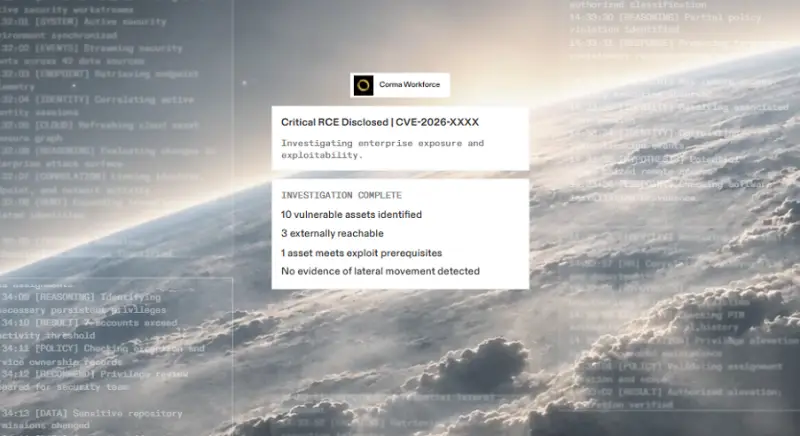
Corma.ai has raised $125 million to expand its cybersecurity-focused AI models and the infrastructure behind them. The Series A round was led by NEA, with returning investors Khosla Ventures, Coatue and Sequoia Capital also participating. Corma is now valued at $1 billion.
The funding comes as security teams weigh where AI can help with breach response and where its limitations could add risk. Corma’s central claim is that general-purpose language models can be more effective at carrying out cyberattacks than at detecting or fixing them. Its products aim to close that gap by analyzing data from security tools, investigating alerts and recommending remediation steps.
Corma’s test highlights an offensive-defense gap
In a test described by Corma, several large language models were asked to hack a simulated corporate network. Across 85% of test runs, the models succeeded in installing a malicious file. They identified only 12% of the malicious files they had installed themselves.
Those results point to a specific concern for security operations: a model that can perform a harmful action may still struggle to recognize the traces it leaves behind. Corma argues that this imbalance could give attackers an advantage over defenders. The test was conducted in a simulated environment, so the figures describe those runs rather than outcomes across live company networks. Still, they help explain why the startup is building models around defensive work rather than relying solely on general-purpose systems.
Corma says its models can speed up some breach-response workflows by a factor of 100 and lower the related costs. Those are company claims; the funding announcement does not provide the test conditions or cost figures behind them. For security teams assessing the product, the practical questions are which tasks were timed, what human review was included and whether the claimed gains hold against their own alert volumes and response procedures.
Benchmark claims focus on task performance and speed
Corma says one of its models outperformed GPT-6 Astra, Claude Opus 5.5 and other large language models in DefenseBench V5. The evaluation measures how reliably a model completes defensive cybersecurity tasks and how quickly it does so. The information provided does not include scores, task breakdowns or details about how the competing models were configured, which makes the result difficult to compare independently.
That distinction matters for administrators and security leaders. A benchmark result can help identify promising systems, but deployment decisions also depend on how a model handles an organization’s tools, log formats and escalation rules. Teams will want to understand what the benchmark counted as a successful response, how it treated uncertain findings and whether its tasks resemble their own investigations. Corma’s claims establish its stated position in the evaluation; they do not, by themselves, show how the model will perform in every customer environment.
Alert volume and missing logs complicate automation
Corma’s models analyze telemetry from firewalls, network-monitoring software and other cybersecurity applications. The company says the system can identify threats and provide remediation guidance. In principle, drawing on several tools can give investigators a broader view of an incident than any single alert provides. The value of that approach depends on what data is available and how well the model can connect activity across systems.
Security teams already face a difficult sorting problem: investigations can involve false positives, repeated alerts and incomplete evidence. Corma also points to log retention as a constraint. Some companies discard security logs after a relatively short period to limit storage costs, leaving investigators with less historical data to examine. That means autonomous analysis may depend as much on telemetry coverage and retention choices as on the model itself.
Corma says its algorithms can investigate breaches autonomously and alert a relevant security team member when human input is needed. Staff can also guide the models through a Slack chatbot. One example the company gives is asking the system to check whether malware removal from a compromised server was successful.
For teams considering this kind of workflow, the operational detail to examine is how the system decides when to escalate, what evidence it presents and which remediation actions it can recommend. Corma’s example describes a request for a follow-up check; it does not specify whether the product makes changes to customer systems on its own. That distinction will matter when teams define review and approval steps around automated investigations.
Funding will support infrastructure and model development
Corma has offices in San Francisco and Tel Aviv. Co-founder and Chief Executive Officer Alon Pluda said demand from large organizations had been strong since the company emerged from stealth, and that securing enough capacity to meet that demand had been a challenge. The company plans to use the new funds to buy more infrastructure and improve its AI models.
That investment addresses two connected demands: processing security data for customers and continuing work on models tuned for defensive tasks. For IT leaders, the next useful evidence will be customer deployment details, benchmark methods and clearer information about how the system fits into existing response workflows. The funding gives Corma room to expand; its claims about speed and model performance will need to be judged against the results security teams see in their own environments.


