Five Ways CIOs Can Use AI to Strengthen Cybersecurity
- Ana Martins
- 763 views
Gartner analyst Leigh McMullen says automation, faster sharing, patch testing and recovery practice can help security teams counter AI-assisted attacks.
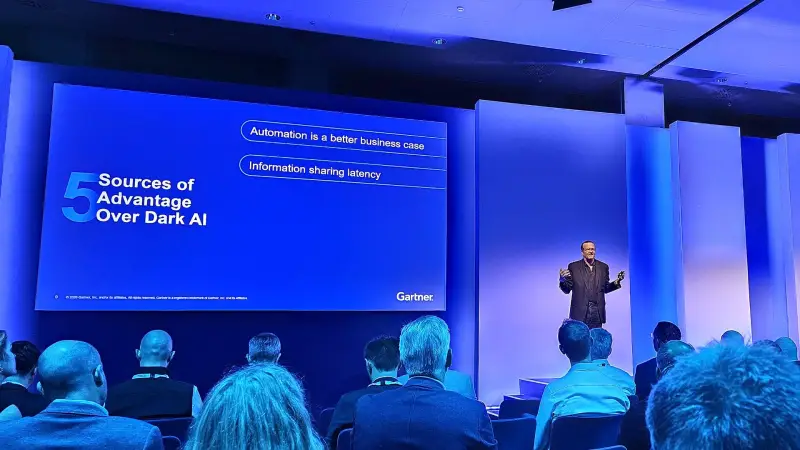
AI gives attackers new ways to find and exploit weaknesses, but Gartner analyst Leigh McMullen sees room for defenders to gain ground. His advice to CIOs: build repeatable capabilities around automation, information sharing, patching and recovery, rather than treating each new AI model as a cybersecurity turning point.
The concern is real. Verizon’s 2025 Data Breach Investigations Report recorded a 34% increase in vulnerability exploitation last year. Gartner expects vulnerability discovery to “skyrocket” in the next few years. Yet McMullen, a distinguished VP analyst and Gartner fellow, argues that AI is a tool whose effect depends on how it’s used and what an attack achieves.
Speaking at Gartner IT Symposium/Xpo 2026 in Barcelona, he outlined five ways security teams can turn AI’s arrival into an operational advantage. His broader message to CIOs preparing for board discussions: focus on capabilities the organization can build and demonstrate, even as attack methods change.
1. Scale security through automation
Security teams have long tried to keep pace with attackers through new ideas and techniques. McMullen argues that innovation alone can’t keep up with large numbers of adversaries. Automation offers a stronger business case because it can expand the work defenders already do.
AI may accelerate attacks, but McMullen expects attackers’ growing reliance on AI-assisted attack paths to create weaknesses of its own. Security teams, by comparison, already automate parts of their work. He said that automation investments can increase in value over time: the systems and processes built today can cover more services and revenue as the organization grows.
For CIOs, the practical question is whether security automation can extend coverage without requiring the same growth in manual effort. McMullen presented it as a way to scale defensive work, not as a guarantee that attacks can be stopped.
2. Reduce the delay in sharing vulnerability information
McMullen says defenders have a structural advantage in vulnerability information. Security professionals publish vulnerability records and share discoveries through established communities; attackers, he said, don’t share their findings freely.
That advantage depends on teams making useful information available to one another. McMullen urged security groups to share insights across industries, even where the organizations involved compete in other areas. Wider circulation of knowledge about exploits can make attackers’ work harder, while helping defenders spot and address weaknesses sooner.
For CIOs and CISOs, this means treating information exchange as part of security operations. Industry communities can help reduce the time between finding a weakness and getting relevant information to the teams able to respond.
3. Use the defender’s AI lead to improve patching
McMullen believes defenders currently have access to stronger AI capabilities than attackers. Even if hostile groups can adapt or distill models quickly, he argued, defenders still have an advantage for some period. The duration could be months, days or hours; the important point, in his view, is using that time effectively.
He identified patching and vulnerability management as a major challenge for CIOs. One possible aid is AI-assisted software reverse engineering, which McMullen said could help teams create digital twins of their environments and test changes against them.
He pointed to customized firmware for synthesizers as an example of reverse engineering becoming more accessible. He asked whether similar methods could help teams examine operational technology devices or map vulnerabilities across cloud and hybrid production environments. If they can, organizations might be able to test patches more thoroughly and bring software changes into continuous integration and delivery workflows.
These are possibilities McMullen raised, not established results for every device or environment. Teams would need to assess whether they can model their own systems accurately enough to make testing useful.
4. Turn knowledge of your systems into an advantage
AI tools still need access to relevant code to find vulnerabilities in it, McMullen said. He noted that open source software remains a major part of the attack surface, while each organization also knows details of its own closed source systems that outsiders may not have.
That knowledge can guide internal testing. McMullen recommended using AI-assisted penetration testing and red teaming against the organization’s own environment to search for weaknesses that might otherwise go unnoticed. Teams need an accurate inventory of the software they run to make this work meaningful; knowing the systems and dependencies they actually operate gives them a better basis for testing.
5. Make attack scale costly for adversaries
AI may be able to assemble complex attack chains, but McMullen cautioned that an attack tailored to a particular environment may not work broadly. A chain that looks threatening in theory can depend on conditions that don’t exist in the intended target.
He described a friend’s experience with Mythos Preview, in which the system identified a four-part attack chain that did not exist and could not be configured as the model proposed. The example illustrates his point: an AI system’s ability to imagine a route through a target doesn’t mean that route is practical or significant.
Running attacks at broad scale also consumes resources, and larger operations can become easier to detect and interrupt. McMullen acknowledged that attackers may steal tokens or other resources, but argued that scaling activity still brings greater exposure. His view is that defenders can benefit when attackers must choose between expensive, target-specific work and noisier broad activity.
Build resilience that teams can prove
McMullen’s five advantages lead to a practical priority: prepare to recover when an attack succeeds. Gartner has seen little to no impact on earnings per share six months after a breach, he said. He stressed that this isn’t a reason to accept breaches; his argument is that resilience can limit harm and provide a measurable area of improvement.
He urged CIOs to work with their CISOs on recovery rehearsals. Teams should practice rebuilding deployment, test and production environments from immutable backups, and verify where those backups are and how to access required keys, including BitLocker keys. Regular practice can reveal gaps before a real recovery depends on the process.
McMullen said AI may make it easier to carry out some of this work. He suggested that CIOs could show boards evidence of continuous improvement by rebuilding production on a regular schedule or testing whether AI-assisted coding can support a major migration. His point is that recovery readiness can be rehearsed and demonstrated even when no security design can promise protection from every newly discovered vulnerability.
For IT leaders, the next step is to make these capabilities concrete: assess where automation can extend security work, improve information sharing, evaluate AI-assisted testing, and rehearse restoration from backups. McMullen’s argument is that prepared teams can reduce the damage an attacker causes—and get better at doing so over time.


