Gartner Forecasts 1.7 Million Net Jobs Added From AI by 2030
- Robert Miller
- 890 views
Gartner projects AI will create 10.6 million jobs and eliminate 8.9 million by 2030, while hiring delays and entry-level roles remain pressure points.

Gartner expects AI to add more jobs globally than it eliminates by 2030, but the gains won’t arrive evenly or immediately. Its forecast, which excludes China and India, projects 10.6 million jobs created and 8.9 million lost by the end of the decade: a net increase of 1.7 million. Gartner estimates that AI will account for job losses affecting, at most, around 1.8% of the workforce during that period.
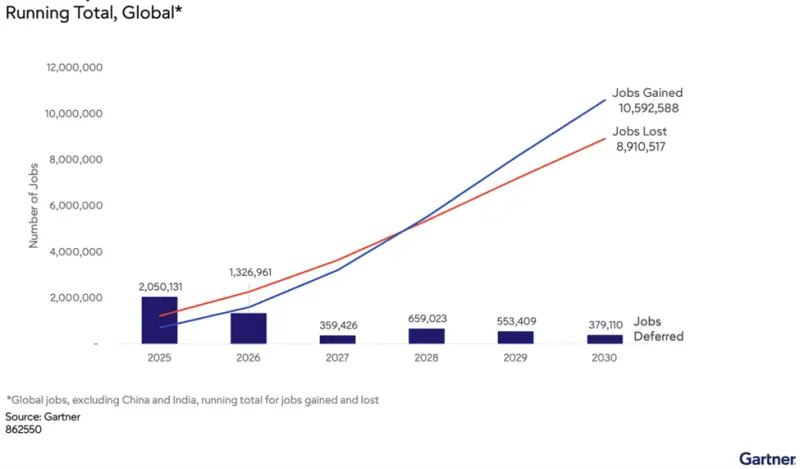
Those totals leave out another effect that may be more visible to employers and applicants today: delayed hiring. Gartner forecasts that 5 million jobs will be deferred cumulatively through 2030. These are positions that might otherwise have been created, but for which employers hold back hiring while they assess AI projects or use those projects to justify restraint. Gartner counts deferred jobs separately from positions eliminated.
“Job deferrals were the first effect felt from AI,” said John Lovelock, Gartner distinguished VP analyst and chief forecaster. He said employers waited to fill open roles while they assessed the effects of their AI projects. That distinction matters for workforce planning: a role left vacant for a period isn’t automatically a permanent reduction, though some delayed openings may eventually disappear.
Losses lead in the near term
Gartner’s forecast puts AI-related job losses ahead of job creation in 2026: 2.2 million positions lost against 1.6 million gained. Lovelock expects that balance to shift as organizations become more successful with AI deployments. He said the reversal would come after AI moves through the Trough of Disillusionment, a stage in Gartner’s Hype Cycle framework.
The forecast also shows delayed hiring easing over time. Gartner estimates that 1.3 million people experienced a hiring delay during 2026, down from 2.1 million the previous year. By 2030, the firm expects 400,000 jobs to be deferred. For employers, that projected decline suggests that some hiring restraint may be temporary as organizations learn which AI projects deliver enough value to change staffing plans.
Another indicator points to continued hiring appetite among some large employers. In a survey of 400 US CEOs, KPMG found that 89% expected to increase headcount over the following three years. KPMG US CEO Tim Walsh linked the outlook to AI adoption in an Axios interview. The survey and Gartner forecast measure different things, so they shouldn’t be read as direct comparisons: one reports CEO expectations, while the other estimates job creation, losses and delays.
Technology and services show different paths
Gartner projects the technology industry will record the largest net job increase among the sectors it assessed. By 2030, it forecasts 1.9 million technology jobs created and 400,000 lost. Services, including financial services, are also expected to gain jobs overall, despite substantial losses in those industries.
That services outlook marks a change from Gartner’s 2025 forecast, which anticipated more jobs lost than created in the sector. The firm now sees demand growing for data- and system-oriented skills. Lovelock said services businesses are particularly able to raise employee productivity while expanding employment. The forecast doesn’t specify which roles will benefit, so employers will need to track their own demand for those skills instead of assuming that every services team will grow.
Gartner expects some newly created positions to support AI directly, including work to implement, maintain and scale systems. The firm doesn’t identify specific job titles or estimate how many openings will fall into that group. That leaves organizations with a broad direction to monitor, rather than a role-by-role staffing plan.
By contrast, Gartner expects public sector employment to face the largest net job decline of any industry. Lovelock said that without revenue growth or industry transformation as incentives, those organizations may focus on using AI to improve efficiency and reduce staffing.
Entry-level roles face the sharpest delay
Gartner expects entry-level positions to be especially exposed to delayed hiring. Lovelock said many deferred roles are eventually filled after a 12- to 24-month delay, but some turn into permanent losses. He also expects the mix of positions to shift toward senior roles across many industries, a change that could narrow the usual path for workers to build experience.
A separate Gartner forecast from September estimated that an average of 30% of positions eliminated in AI-related layoffs would be refilled by 2029. For enterprise-sized organizations, the estimate was around 40%. Those figures point to a potential staffing cost beyond initial reductions: employers may later need to restore roles after discovering that the work still needs people.
For IT and business leaders, the useful distinction is between jobs removed, jobs postponed and jobs created elsewhere. Gartner’s figures describe a net increase by 2030, but they also point to near-term losses, slower entry-level hiring and substantial differences by sector. Teams assessing AI’s workforce effects should watch whether planned projects deliver measurable results, which skills become harder to recruit, and whether delayed openings return as organizations gain experience with deployment.


