Synology RackStation RS4826xs+ Review: 10GbE Speed, 48-Drive Expansion and DSM 7.4
- Dave Mitchell
- 375 views
The 2U RS4826xs+ combines fast 10GbE storage, support for up to 48 drives and DSM 7.4 apps, with certified-drive limits and a £4,869 starting price.
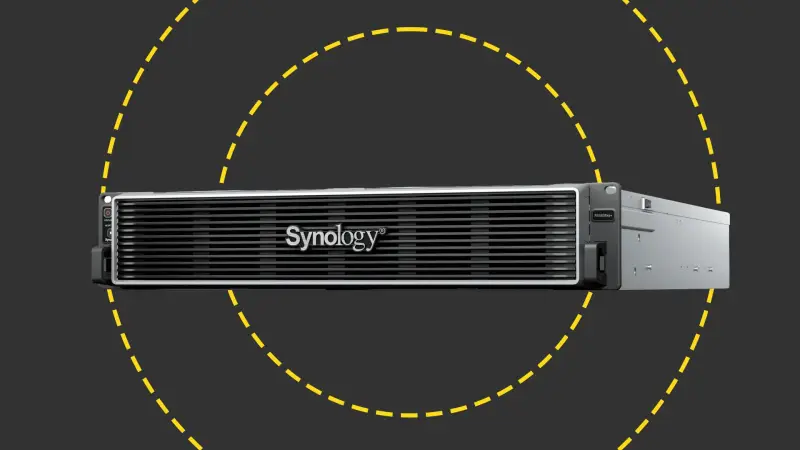
Synology’s RackStation RS4826xs+ pairs strong 10GbE performance with room to scale to 48 drives, making it a capable storage platform for growing businesses. Its 2U chassis, redundant power supplies and high availability support suit environments where storage access and recovery matter. There are trade-offs to weigh: DSM restricts drive use to certified models, and some AI features require additional hardware.
The RS4826xs+ is not a direct replacement for the older RS3621xs+; Synology positions the RS3626xs for that role. Instead, the new model looks like a successor in practice to the discontinued 3U, 16-bay RS4021xs+. It brings a newer processor, dual 10GbE, and a smaller chassis, while increasing expansion capacity by eight drives. A diskless unit was listed by Broadbandbuyer at £4,869 excluding VAT, and includes a five-year hardware warranty.
Capacity, connectivity and redundancy
The appliance has 12 SATA bays for large or small form factor drives. Add as many as three RX1225RP disk shelves and the total reaches 48 drives. That gives administrators room to expand without replacing the main chassis, though the extra shelves and drives add to the full deployment cost.
Inside, an 8-core Intel Xeon D-1739 running at 3GHz replaces the older Xeon D-1541 found in many previous RackStations. The standard configuration includes 16GB of ECC DDR4 RDIMM memory. Six memory slots allow upgrades to 96GB without replacing the base module. Synology’s certified D4ER02-16G memory modules were described as expensive, so memory expansion is a cost to factor into sizing.
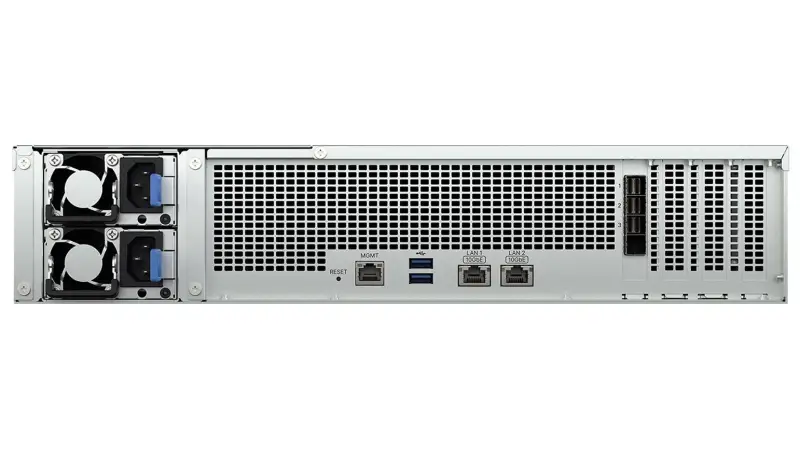
Network ports comprise two 10GBase-T connections and a Gigabit out-of-band management port, which can keep management access separate from normal data traffic. The RS4021xs+ had four Gigabit ports; those are gone here. Two free PCIe Gen4 x8 slots can add networking, including single- or dual-port 10GbE and 25GbE adapters. The chassis has four PCIe slots in total: one holds a quad-port SATA controller for the drive backplane, and another connects to the expansion shelves.
The shelf connection card has four external ports, but only its top three are enabled in this model. There are no onboard M.2 slots. For NVMe storage, administrators can install Synology’s E10M20-T1, which combines 10GbE and dual NVMe support, or the M2D20 dual NVMe card. The system also includes two 550W hot-plug power supplies and four hot-plug cooling fan modules, supporting serviceability and component redundancy in the rack.
DSM 7.4 backup and AI services
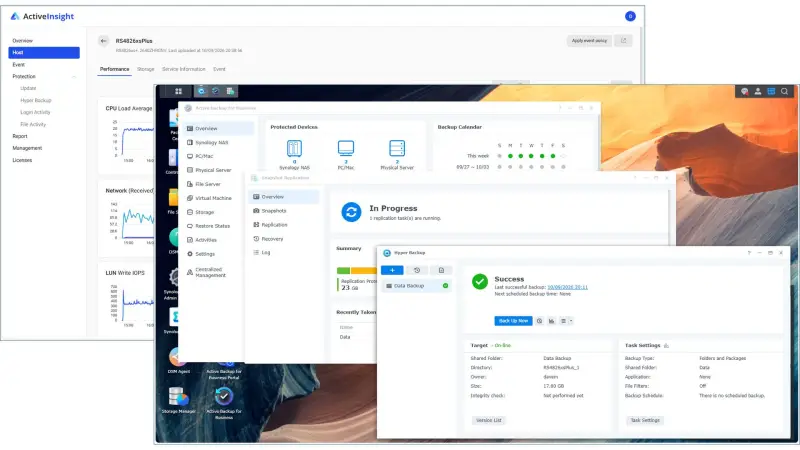
DSM 7.4 is installed through a browser-based setup process. Its data protection tools include Snapshot Replication for NAS shares and thin-provisioned iSCSI LUNs, volume encryption, and WriteOnce settings for Enterprise or Compliance WORM policies on shares. Hyper Backup covers local and remote destinations, Rsync, cloud targets and iSCSI LUNs.
Synology’s Active Backup apps extend protection to Google Workspace and Microsoft 365, as well as servers, workstations, VMware and Hyper-V environments, and remote Synology appliances. That breadth may help teams consolidate backup tasks on the NAS; they should still check that the included functions match their recovery requirements and existing platforms.
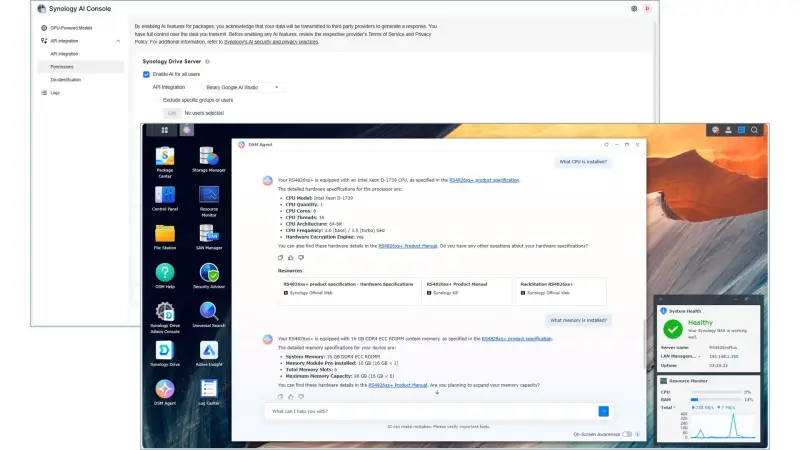
DSM also includes AI features. A DSM agent offers guidance on system configuration, with a later version expected to add automated workflows for tasks such as backup validation and health monitoring. Synology Drive’s AI search requires one of four compatible Nvidia GPUs, so it isn’t available simply by installing the base appliance.
In AI Console, administrators can select services from OpenAI, Amazon Bedrock and Google AI Studio, choose a generative model and enter an API key. Integration with MailPlus, ChatPlus, Meet and Office enables translation and chat functions. A De-identification option can anonymise personal details such as UK national insurance and driver licence numbers before processing. Teams considering these cloud-connected features should review their data handling needs and confirm which services they intend to enable.
Measured 10GbE performance
The review tested four 4TB Synology HAT5300 hard drives in RAID5. DSM enforces Synology’s drive certification policy: unrecognised third-party devices are flagged and cannot be used. Synology drives also receive firmware updates through Storage Manager, reducing the need for administrators to handle updates manually.
For file testing, a NAS share connected over 10GbE to a Dell PowerEdge running Windows Server 2025. Iometer recorded sequential read and write rates of 9.3Gbits/sec. Copying a 25GB file returned 5.3Gbits/sec for reads and 5.6Gbits/sec for writes. A backup of a 22.4GB folder containing 10,500 small files averaged 2.3Gbits/sec.
iSCSI results were similarly strong. A single 10GbE link to a 500GB target delivered 9.3Gbits/sec for both reads and writes in Iometer. With dual 10GbE multipath I/O, measured rates reached 18.5Gbits/sec for reads and 17Gbits/sec for writes. These are test results from the stated setup; actual throughput will depend on the drives, network and workload.
Fit for growing storage needs
The RS4826xs+ makes a strong case for businesses that need fast shared storage now and a clear expansion path later. Its 10GbE results, optional 25GbE networking, 96GB memory ceiling and 48-drive maximum cover a range of file, backup and iSCSI workloads. DSM adds snapshot, backup and security tools, while the five-year warranty strengthens the package at the listed diskless price.
Before purchase, administrators should account for certified-drive requirements, the cost of Synology memory and any shelves or network cards needed to reach their planned capacity. The key sizing question is whether the base dual 10GbE configuration and 12 bays meet current needs, or whether the deployment will depend on paid expansion. For teams that can work within those constraints, the RS4826xs+ offers substantial performance and growth in a compact rack footprint.
Synology RackStation RS4826xs+ specifications
| Chassis | 2U rackmount |
| CPU | 3GHz 8-core Intel Xeon D-1739 |
| Memory | 16GB DDR4 ECC RDIMM; maximum 96GB |
| Storage | 12 x SATA LFF/SFF |
| RAID | RAID 0, 1, 10, 5, 6, F1, JBOD |
| Expansion | 3 x mini-SAS HD ports; 2 x PCIe Gen4 x8 slots |
| Network | 1 x Gigabit OOB management; 2 x 10GBase-T |
| Other ports | 2 x USB 3.2 Gen1 |
| Power | 2 x 550W hot-plug PSUs |
| Management | Web browser |
| Warranty | 5 years |


