SiMa.ai Palette 3.0 Targets Concurrent AI Workloads on Modalix Chips
- Duncan Riley
- 873 views
Palette 3.0 adds concurrent model execution, speculative decoding and support for GPT-OSS-20B on SiMa.ai’s 16GB Modalix module.
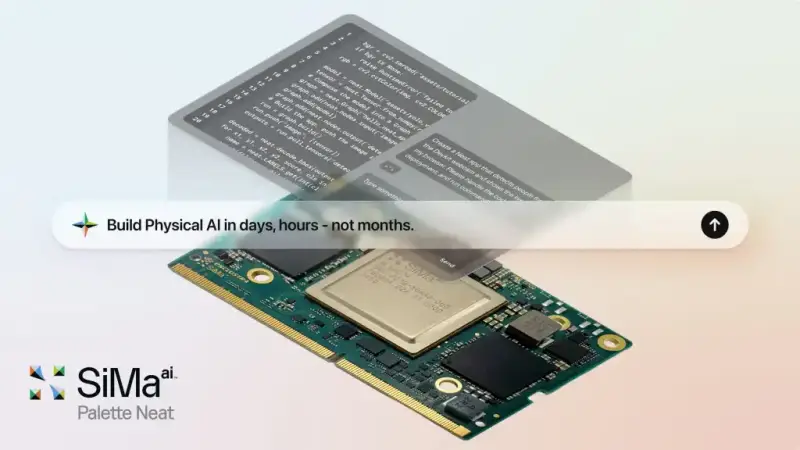
Running several AI workloads on a device can make a robot or drone more capable, but it also puts pressure on compute, power and integration. SiMa.ai’s Palette 3.0 software suite is designed to address that combination: it runs multiple models concurrently on the company’s Modalix MLSoC and, SiMa.ai says, can increase model throughput by up to 3.5 times.
The release is aimed at developers building autonomous machines that need to process AI workloads on the device. That includes drones and robots, where sending every task to a data centre may not suit the system’s operating requirements. SiMa.ai positions its platform around this kind of physical AI workload, combining its own silicon with software for deployment on physical devices.
Concurrent models and containers
Palette 3.0’s main change is improved concurrent model execution on the Modalix MLSoC. A single chip can run reasoning and multimodel workloads at the same time, while also keeping to what SiMa.ai describes as a low-power profile. The platform can run separate Docker containers on the chip, giving developers a way to package and run distinct workloads within the same system.
Supported workloads include large language models (LLMs) and vision-language models (VLMs). For device developers, running these alongside other AI tasks can reduce the need to divide work across multiple compute platforms. The practical result will depend on the models and application, but the central change is that Palette 3.0 is built to schedule different types of work concurrently on the same Modalix chip.
That matters for autonomous systems with several demands at once. A machine may need to interpret visual input, estimate depth and carry out higher-level reasoning. Running those workloads together makes model throughput and the power budget relevant to the whole design, not just to one model in isolation. SiMa.ai’s figures should therefore be assessed against the workload a team expects to deploy.
Throughput and expanded model support
SiMa.ai attributes the claimed throughput increase of up to 3.5 times to speculative decoding. Palette 3.0 uses the EAGLE3, DFlash and Gemma 4 MTP algorithms for this capability. The company has also added support for large mixture-of-experts models, including OpenAI Group PBC’s GPT-OSS-20B. That model can run on the Modalix MLSoC 16GB system-on-module.
The published maximum is a company-reported figure, and the available material does not specify a test configuration or a direct comparison workload. Developers evaluating the release will need to check how the gain applies to their model, task and device constraints. SiMa.ai says a new Model Registry reports performance for models measured within real-world power constraints; it offers further competitive benchmarking details on request.
Perception, depth and reasoning models used in robots and drones are also described as faster in Palette 3.0. The release adds work developed with ecosystem partners: unified sensor fusion, dense neural depth fields and closed-loop digital twin simulation. These capabilities address parts of the development process where teams must combine sensor data, estimate the surrounding environment and test system responses.
Development and validation work
Integrating those pieces can take time because models, sensors and simulation tools need to work together and be validated as a system. SiMa.ai says the new additions are intended to reduce those integration and validation bottlenecks. For development teams, the relevant question is how well the supplied tools fit existing workflows and whether their test results represent the conditions the device will encounter in use.
Palette 3.0 follows Palette Neat, an agentic development environment launched in June. Together, the software is positioned to support development across model execution and application building. The release also includes open-source capabilities for generative AI applications. Developers can adapt that code through SiMa.ai’s GitHub organization, while Palette 3.0 documentation is available through the company’s Developer Center.
SiMa.ai was founded in 2018 by Chief Executive Krishna Rangasayee. Its platform combines purpose-built silicon and software for AI workloads on physical devices. The company lists Robert Bosch GmbH, Emerson Electric Co. and Synopsys Inc. among its customers and partners.
For teams assessing Palette 3.0, the key checks are straightforward: confirm that the target model is supported, compare Model Registry results with the intended device workload, and validate concurrent execution within the system’s power limits. The throughput claim gives developers a reason to evaluate the release; workload-specific measurements will show whether it changes the design of a particular robot or drone.


