Nvidia’s SC26 Stack Puts Scientific AI Agents at the Center of HPC
- Zeus Kerravala
- 552 views
Nvidia’s SC26 announcements connect CPUs, GPUs, quantum systems and software around faster scientific discovery loops. Key products are still years from delivery.
Nvidia’s SC26 announcements point to a change in how scientific computing may be judged: by how quickly researchers can move from a question to a useful next experiment, not just by how fast a machine completes one calculation. The company presented hardware, models, software libraries and workload tools designed to let AI agents run simulations, inspect results and help choose what to do next.
That broader approach matters to IT and research teams planning infrastructure. The machine is becoming one part of a loop that includes models, data, networks and schedulers. Nvidia’s portfolio now reaches across those layers, though many of the performance figures it presented come from Nvidia or its partners and need validation against each team’s own workloads.
Faster loops become a performance measure
At the show, Nvidia introduced open science models, a CPU-only supercomputing rack, an HPC-focused GPU, CUDA-X libraries, quantum integration for the Slurm workload manager, and a quantum co-design platform with IBM and Fermilab. It also announced a co-packaged optics deployment at Lambda and marked 20 years of CUDA. Together, the releases describe a platform intended to support agents that reason about scientific questions and repeatedly call computing tools.
“For agents tackling science and engineering, faster simulation means faster discovery,” said Ian Buck, Nvidia’s vice president of hyperscale and high-performance computing, while introducing Rubin HPC. In this model, a simulation is one step in a cycle: an agent proposes or refines a hypothesis, runs a calculation, examines the result and decides what to test next.
That changes the bottleneck. If an agent can produce thousands of possible molecules or material designs, the limiting factor may be how quickly researchers can evaluate candidates. Nvidia says its cuPhoton library cut the time needed to correlate Event Horizon Telescope black-hole data from more than a month to eight minutes. At Pacific Fusion, a Nemotron-powered agent can analyze plasma simulations as they run, giving researchers an opportunity to steer the work before it finishes.
Lawrence Berkeley National Laboratory is using Nvidia’s DAQIRI networking library to bring electron-microscopy analysis into the experiment itself. Researchers can use incoming results to decide what to measure next while data collection is underway. These examples make a case for measuring time-to-insight per iteration alongside the time required to finish an individual job.
Open models meet specialized research data
Several of the reported model results came from research companies adapting Nemotron with domain-specific information. Lila Sciences post-trained the model using lab feedback and nearly doubled its accuracy on quantum-dot synthesis protocols, reaching 61%. Nvidia says that result topped GPT-6 Astra’s 54% while costing 10 to 20 times less for inference. Therna nearly doubled accuracy over frontier models when predicting mRNA protein-expression ranges. Terray Therapeutics trained the model to identify reactants, products and conditions in chemistry diagrams.
These results illustrate why specialized models can appeal to research teams. Research data may be proprietary or regulated, and experimental outcomes can provide training feedback that general-purpose models lack. Teams may also want models running on infrastructure they control. The results cited at SC26 are specific to the tasks described; they don’t establish that a domain-tuned model will outperform a general-purpose model on every scientific workload.
Nvidia optimized Nemotron 3.5 Super VL to run on a 128GB DGX Spark. KTH Royal Institute of Technology reports that an agent built on the model fixed 81% of broken GROMACS molecular-dynamics setups during a single overnight run on one Spark. Nvidia is also releasing datasets and training recipes alongside model weights. For research teams, those materials could help with adaptation, although the quality of the resulting system will still depend on the available data and the task.
CPUs, GPUs and Slurm in one workflow
Nvidia is extending its ambitions into CPU-bound HPC with Vera, a CPU-only rack aimed at work that has historically run on x86 systems. In Nvidia’s testing, Vera delivered 1.9 times the performance and 2.4 times the performance per watt of x86 on an OpenFOAM airflow simulation. Nvidia also reported twice the energy efficiency of x86 on the Weather Research and Forecasting model.
DKRZ, the German Climate Computing Center, has selected Vera for its HLRE-5 system. A beta Fortran compiler is part of that effort. Much scientific software is written in Fortran, so supporting existing code can reduce the work involved in evaluating a new CPU platform. The announced performance figures are vendor tests, however; teams should compare them with their own applications and operating conditions.
Across Nvidia’s portfolio, Vera targets CPU-bound simulation, while Rubin HPC is designed for sparse, memory-bound scientific work rather than AI training. DGX systems can sit alongside IBM quantum computers. Nvidia is also extending Slurm so it can schedule quantum processing units alongside CPUs and GPUs through familiar commands.
Nvidia says nearly 30 data centers are deploying more than 50 quantum processors. Alice & Bob, IBM, IQM, Pasqal and Quantinuum have adopted the expanded Slurm support. The aim is to let an agent request different types of computing as a workflow requires them: for example, a CPU-based molecular-dynamics job, a GPU-accelerated docking run and, eventually, a quantum-chemistry calculation.
Quantum computing shifts toward integration
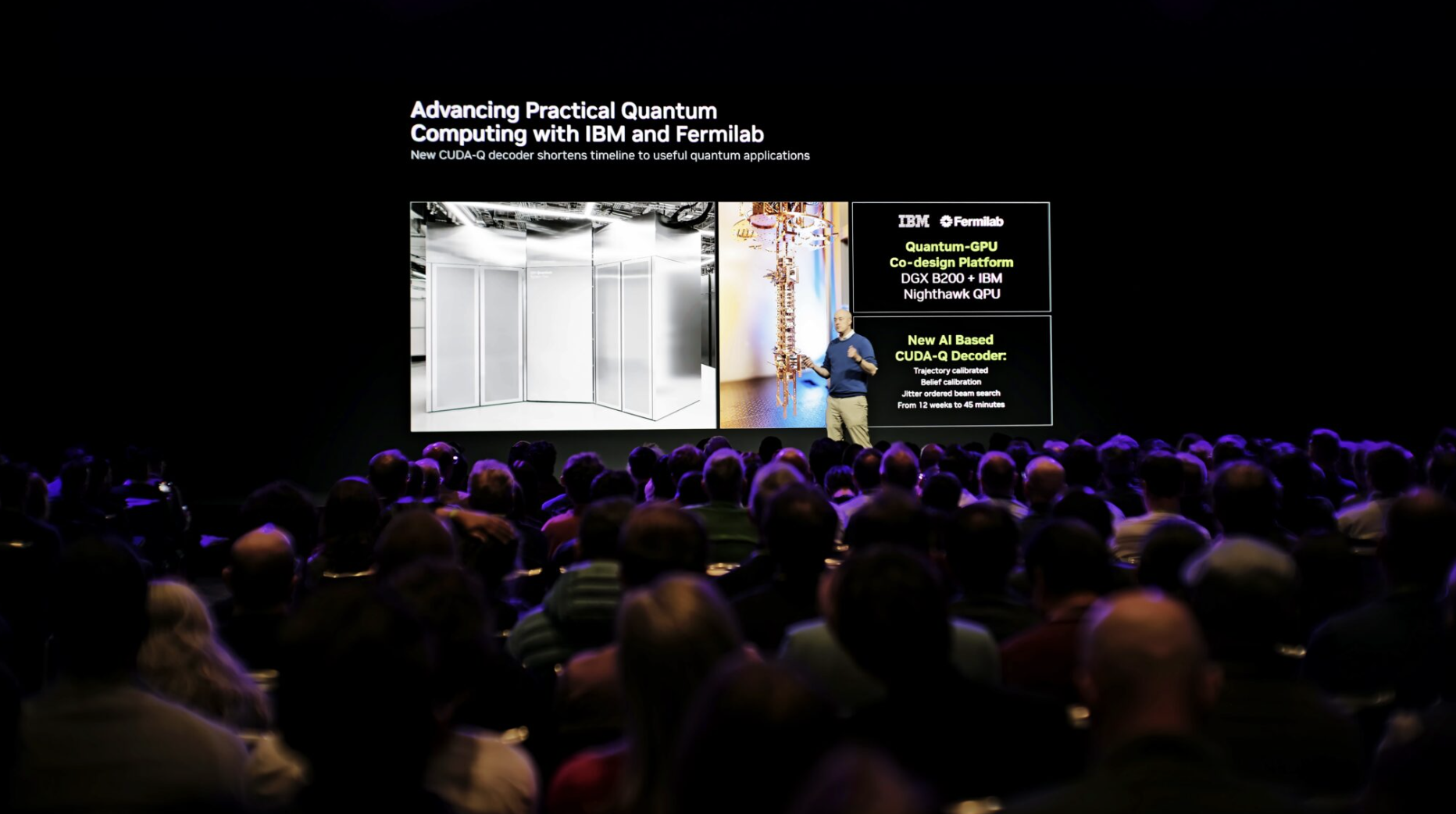
The quantum work at SC26 focused on error correction, decoding and integration with classical computing. Nvidia’s TCBP-JOBS decoder, available in CUDA-Q QEC 0.9.0, delivers up to 13,000 times faster decoding for error-correction research, according to the company. Nvidia says some design studies can be reduced from 12 weeks to 45 minutes.
IBM and RIKEN’s hybrid quantum-classical chemistry work, which modeled protein-ligand complexes with up to 12,635 atoms, is a Gordon Bell Prize finalist. “Scaling quantum and classical together will open new frontiers in high-energy and nuclear physics and beyond,” said IBM’s Jerry Chow. The collaboration reflects a practical dependency: quantum systems still need classical computing for tasks such as simulation, control and decoding, whatever approach to building qubits ultimately proves most useful.
Power and network behavior affect research time
Power is increasingly a constraint on how much useful computation a facility can support. Energy consumed by overhead is energy unavailable to scientific jobs, which helps explain the attention to performance per watt in Nvidia’s Vera results.
At the network layer, Lambda deployed co-packaged optics switches across more than 10,000 GPUs. The company observed latency reductions of about 4% at rack scale and up to about 10% at pod scale. Median optics temperature was 36 degrees Celsius, compared with 51 degrees for pluggable optics. Nvidia says the approach can be up to five times more power-efficient and up to 15 times more reliable than pluggable optics, with light sources that engineers can replace in the field.
For continuous agent workflows, network interruptions can delay multiple dependent steps. That makes availability and latency relevant to research throughput, as well as to conventional batch-job performance. Lambda’s deployment is an early large-scale example for co-packaged optics in a neocloud setting; teams assessing the technology will want to examine the reported conditions and their own network demands.
CUDA remains central to the stack
Nvidia marked CUDA’s 20th anniversary at SC26. The software was introduced at SC06, and the company reports that more than 11 million developers now build on CUDA, with more than 1,000 CUDA-X libraries. Hardware may set the ceiling for performance, but libraries determine how much existing software and expertise can use it.
Agents make the library collection more consequential. A researcher may know a few tools well; an agent can potentially call many tools as a task unfolds. Each library can add a capability to applications built on Nvidia’s platform, reinforcing the value of the surrounding software as well as the processors.
Several headline products remain on a longer schedule: Rubin HPC and HLRE-5 are not expected until 2028. Buyers should treat Nvidia’s and its partners’ figures as starting points for evaluation, then test against their own codes, data and facility limits. Nvidia’s emphasis on open models, datasets, libraries and Slurm contributions also raises a practical question for technical teams: how much control and portability will they have across a stack that increasingly connects processors, software and orchestration?
The direction is clear even if the delivery timelines and workload results still need scrutiny. Nvidia is building toward a system in which an agent can reason, simulate, measure and refine through a connected set of tools. For HPC teams, the useful measure will be whether that system shortens the path from a research question to the next informed decision.


